
Marc Chagall Belarusian - French, 1887-1985
Works
-
 Le clown violoniste à Paris (The Violinist Clown in Paris), c.1970 - 74

Biography
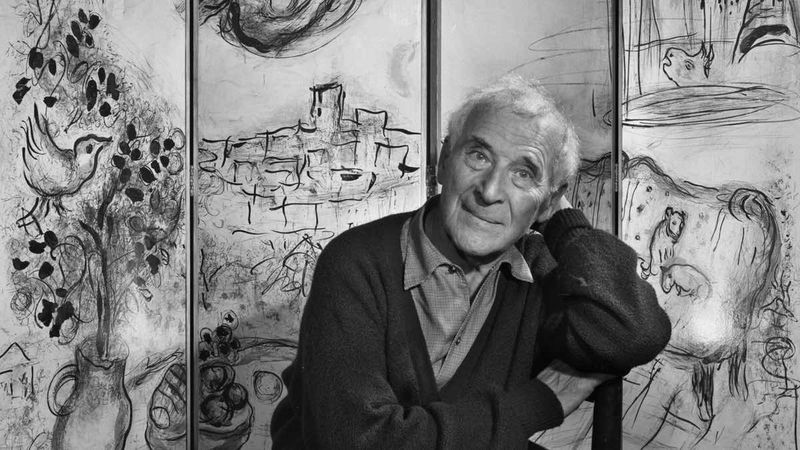
French painter of Belarusian origin, Marc Chagall is renowned for his unique style, combining vibrant colors with dreamlike themes. His work, deeply influenced by his Jewish heritage and experiences of exile, transcends traditional artistic movements.
Marc Chagall was born Moïche Zakharovitch Chagalov in Vitebsk, then part of Imperial Russia, in 1887. Coming from a modest Hasidic Jewish family, he discovered his passion for drawing at an early age and went on to study in Saint Petersburg under the guidance of Léon Bakst, marking the beginning of his professional artistic career.
In 1910, Chagall moved to Paris, where he immersed himself in the avant-garde movements of the time and mingled with artists such as Modigliani, Léger, and Delaunay. It was in Montparnasse that his distinctive style emerged, characterized by vibrant colors and surreal compositions. During this period, he created significant works such as Me and the Village (1911), in which his Belarusian roots blend with Cubist and Fauvist influences.
In 1914, Chagall returned to Russia to marry Bella Rosenfeld. The outbreak of World War I and the October Revolution prolonged his stay, during which he became the commissioner of fine arts in Vitebsk and founded an art school. However, disagreements with Kazimir Malevich eventually led to his departure. Facing rising antisemitism and the threat of Nazism, Chagall went into exile, first in Berlin and then in Paris, before emigrating to the United States in 1941, where he found refuge during World War II.
These years of exile had a profound impact on his work, inspiring powerful pieces such as The White Crucifixion (1938), a poignant response to the persecution of Jews.
After the war, Chagall returned to France and settled in Vence, where his international career flourished. He received prestigious commissions for stained glass and ceiling works, including projects for the Paris Opera Garnier and the Metz Cathedral. His work transcended borders, reaching a global audience. Chagall’s art is marked by dreamlike and poetic imagery, with recurring themes of love, religion, and Jewish rural life. He employed vibrant colors and a mixed technique incorporating oil painting, watercolor, and stained glass, maintaining a style that is impossible to classify yet always lyrical and evolving.
Marc Chagall passed away in 1985 at the age of 97, leaving behind an immense artistic legacy. His works continue to inspire contemporary artists, and museums worldwide celebrate his creative genius through exhibitions and retrospectives. Chagall remains an iconic figure, symbolizing both resilience and the timeless beauty of art.
Exhibitions
-
RÊVE. SURRÉALISME ET RÉVOLTE DE L'ESPRIT
PARIS 25 Apr - 5 Jul 2024Humanity’s deep-rooted fascination for dreams experienced a turning point at the beginning of the 20th century after the publication of The Interpretation of Dreams, by Sigmund Freud (1900), a fundamental...Read more -
The Space of Dreams
BARCELONA 12 Sep 2017 - 5 Jan 2018Through an accurate selection of works of art, the exhibition shows the importance that the dream has had as a constructor of the artistic language of the 20th century to...Read more -
The Space of Dreams
CADAQUÉS 21 Jul - 15 Aug 2017Through an accurate selection of works of art, the exhibition shows the importance that the dream has had as a constructor of the artistic language of the 20th century to...Read more


Publications
News
-
Changer La Vie
A text by Albert Serra July 21, 2017The night is the door to true life, that full life in which the impossible rules and death does not impose its law. It is...Read more -
Artistic Dreams
Llucià Homs in conversation with Hans Ulrich Obrist regarding Sogni/Dreams project Basel July 21, 2017After a few attempts to meet with Hans Ulrich Obrist in London, we finally do so during Art Basel, in one of the terraces of...Read more -
Joan Miró: Dreaming While Awake
Rosa Maria Malet talks about "Surrealism and the Dream" July 21, 2017[Excerpts from the paper given at the Surrealism and the Dream international congress held at the Museo Thyssen-Bornemisza on 8 and 9 October 2013] “I...Read more


